
This article brings together two real scientific discussions that have been repeatedly misunderstood and explains them in a simple way, without conspiracy and without sensationalism.
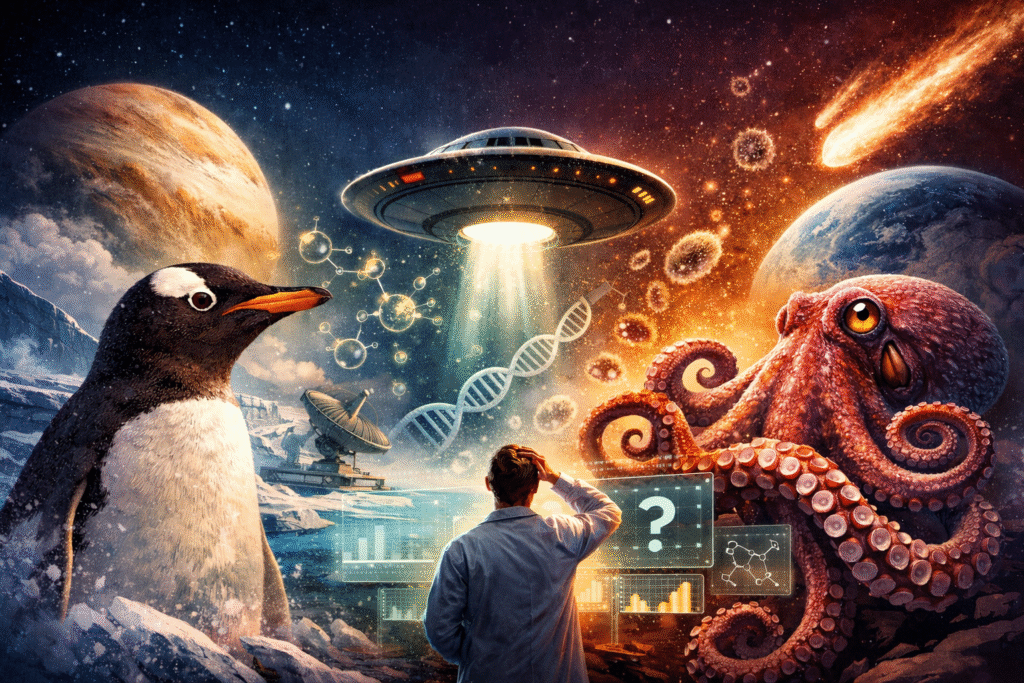
Every few years, a scientific study appears linking certain animals to the idea of extraterrestrial life. Sometimes it is a chemical signal that sounds out of place. Other times, it is an animal so unusual that it seems to challenge what we think we know about evolution. From penguins mentioned in discussions about Venus to octopuses described as almost alien in nature, these studies tend to trigger the same reaction.
But how much truth is there behind these claims? In this article, we revisit two real scientific papers published in recent years and explain what they actually say, without sensationalism, without conspiracy, and without turning speculation into certainty.
Penguins, venus and phosphine
The original phosphine study was led by astronomer Jane Greaves and her team and published in Nature Astronomy in 2020. Using data from the James Clerk Maxwell Telescope and the Atacama Large Millimeter Array, the researchers reported a chemical signal in the clouds of Venus that was difficult to explain with known atmospheric processes.
To help contextualise why phosphine attracted attention, the authors referred to environments on Earth where the gas can be produced naturally, including oxygen poor ecosystems created by microbial activity.
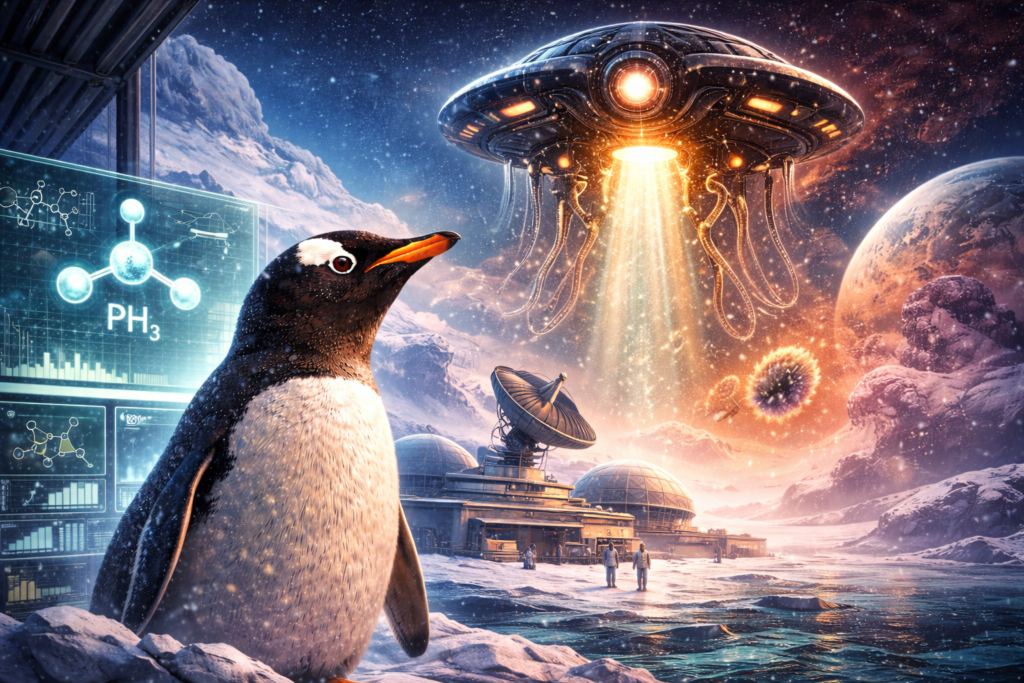
One of those examples came from an unexpected place: penguin colonies. Large accumulations of penguin guano create oxygen-poor conditions where certain bacteria can generate tiny amounts of phosphine. Penguins entered the conversation not because they are biologically unusual, but because their environment helps illustrate how phosphine can exist at all.
This is where the story began to drift. Some media outlets compressed this explanation into something far stranger than intended, loosely tying penguins to Venus itself. In reality, no scientist suggested any biological connection between penguins and another planet. The link is purely chemical and purely illustrative.
Since then, later research has raised doubts about whether phosphine was actually present in the atmosphere of Venus at all, or whether the signal was the result of a misreading of the data. This kind of revision is part of how science works. Initial claims are re examined over time and adjusted when new evidence appears. What matters most is that the discussion is still ongoing, but approached with care rather than certainty.
Octopuses, intelligence, and the “alien” narrative
This story is older than the previous studies linking penguins and aliens.
The second study often cited in discussions about animals and extraterrestrial life comes from a very different place. In 2018, a paper published in Progress in Biophysics and Molecular Biology revisited the hypothesis of panspermia, an idea that explores whether life or pre biological material could travel between planets and influence evolution on Earth.
The paper, authored by Edward J. Steele and colleagues, did not focus exclusively on octopuses. Instead, it examined broader questions about how complex biological innovation may have occurred during periods of rapid evolutionary change, particularly around the Cambrian Explosion.
Octopuses entered the discussion because they represent one of the most unusual evolutionary outcomes known to biology. Their nervous systems are highly developed, largely decentralised, and fundamentally different from those of mammals, which has long made them a subject of fascination for researchers.
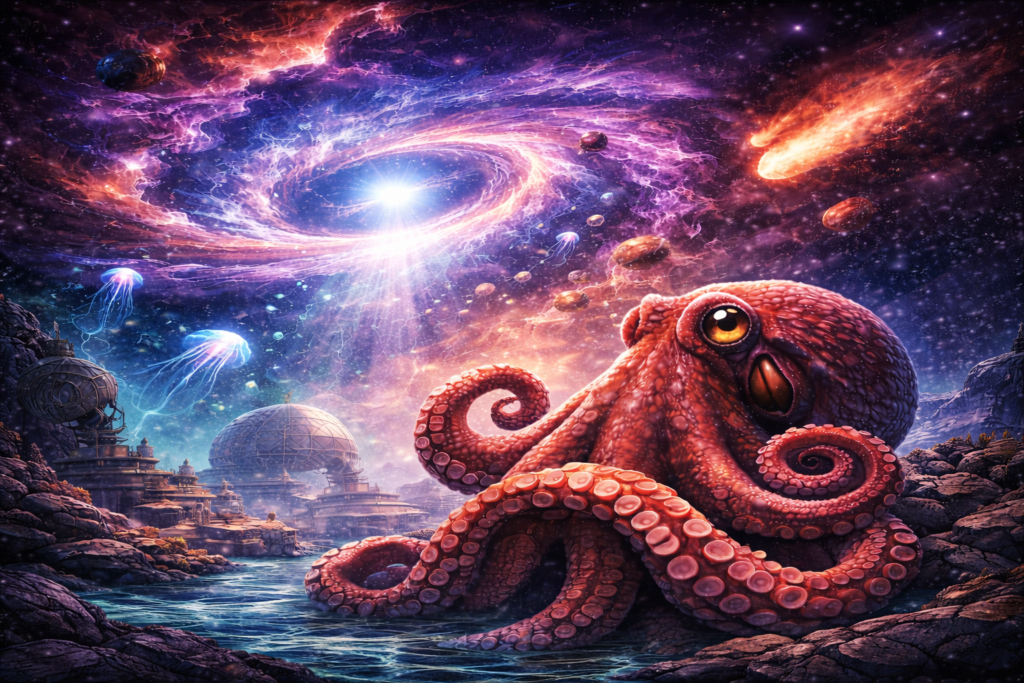
The authors speculated that external biological inputs, such as viruses carried by comets or meteorites, could theoretically have contributed genetic novelty to early life on Earth. From there, a far more dramatic interpretation emerged in the media, suggesting that octopuses themselves might have extraterrestrial origins. This interpretation went well beyond what the paper actually claimed.
the study presented no direct evidence of non terrestrial DNA, nor did it challenge the core principles of evolutionary biology. Most scientists remain unconvinced by the argument, pointing out that the evolution of cephalopods can be explained through established mechanisms such as genetic variation.
Fossil records and genomic research already provide coherent Earth based explanations for their development.
What survived in popular culture was not the cautious hypothesis, but its most provocative possible reading. In scientific terms, the paper remains speculative, interesting as a thought experiment, but insufficient as evidence. The intelligence of octopuses is extraordinary, but extraordinary traits do not require extraordinary origins.
What these two studies actually tell us
Taken together, the phosphine study and the panspermia paper illustrate a recurring dynamic between science and public storytelling. Research that is originally presented with caution and technical restraint often changes once it reaches the media.
Uncertainty is smoothed out, limitations are pushed aside, and complex ideas are reframed into clearer, more striking narratives designed to capture attention rather than reflect the full scope of the research.
In the case of Venus, a difficult to explain chemical signal was quickly framed as a potential sign of life. In the case of octopuses, biological complexity was recast as something almost otherworldly. In both instances, the science itself was not flawed, but the interpretations circulating in public discourse went well beyond what the available evidence could reasonably support.
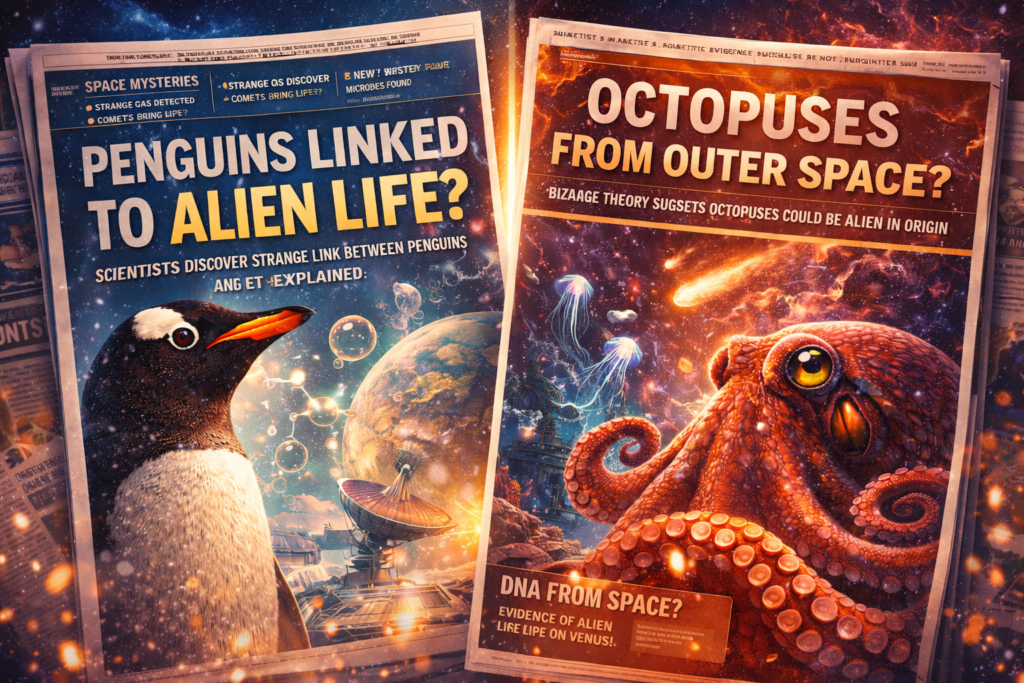
These stories persist because they sit in the grey area between what is known and what remains unresolved. They appear at moments when science has identified something genuinely unusual, but has not yet reached a clear explanation. That uncertainty creates space for speculation, and speculation often spreads faster than careful clarification.
Removed from the headlines, the questions scientists are actually exploring are far more grounded. Researchers are examining how life might leave detectable traces, how intelligence can evolve along very different paths, and how biology could be recognised on other planets without projecting human expectations onto it.
A careful conclusion
Neither penguins nor octopuses point to life beyond Earth. What they reveal instead is how easily scientific uncertainty can be mistaken for discovery once it enters public debate. Both studies remain valuable not because they suggest alien origins, but because they show how science works at its edges, where curiosity is highest and certainty is lowest.
At Tekaroid, these stories matter for that reason alone. They remind us that the most interesting part of science is not the answer, but the process of questioning itself, and that understanding the limits of what we know is often more important than chasing the most spectacular explanation.
