
At Tekaroid, we like to look deeper into technology, and today, in this analysis, we examine how China, the United States and the United Arab Emirates are applying technology in different ways. Can technology project ambition? Can it create opportunity through competition?
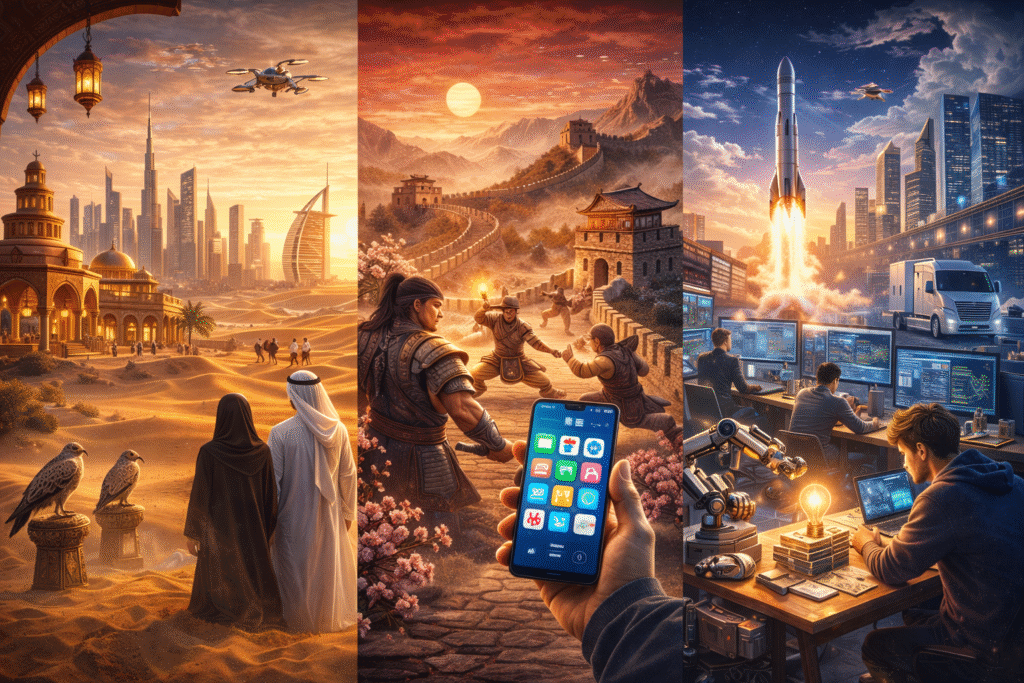
This becomes clear when looking at how different regions use technology in practice. The United Arab Emirates, China and the United States all invest in advanced systems with Artificial intelligence. These areas are filling their cities with automation and digital infrastructure. But they are not trying to build the same future, the interesting is that each uses technology to solve a different kind of problem.
Understanding these differences requires more than listing innovations or celebrating breakthroughs. It requires looking at the ideas behind technology.
UNITED ARAB EMIRATES
The United Arab Emirates has adopted technology as a core instrument of national positioning. Innovation is treated as a visible expression of ambition. Dubai, while only one city within the UAE, has become the example of this strategy.

Technology as identity
Technology is more than just an invention capable of helping human beings and making life easier. In cities like Dubai, it is part of national identity. All the technological infrastructure, with its innovation and intelligent systems, makes people around the world see Dubai as a modern land of opportunity. Technology in the UAE works in two ways at the same time. It improves how the country functions, but also it signals that the UAE is ready to host global business, innovation, tourism and new forms of experimentation.
Practical implementation
Smart government ecosystems integrate digital identity, payments, permits and healthcare access into unified systems. Technology is designed to be experienced daily, not discussed abstractly. For example, The Dubai Metro, operating within the UAE, is the longest fully automated metro system in the world. It is not a showcase project but a functional transport, transporting millions of passengers annually with minimal human intervention.
At the government level, the Dubai Paperless Strategy, aligned with broader UAE digitalisation goals, eliminated paper-based transactions across public services. Residents interact with the state primarily through digital platforms, reducing bureaucracy.
Future
The UAE AI Strategy 2031 is a promise about the future. It is designed to make artificial intelligence part of how the country already works. The idea is simple, instead of adding AI later, it is being built directly into the systems that support the daily life of the citizens.
The strategy focuses on integration rather than experimentation. This means preparing institutions, rules and people so that intelligent systems can operate across different sectors without problem. AI is treated as a tool to improve how decisions are made, not as a temporary innovation or a marketing label. What makes this approach distinctive is its practical mindset. The strategy is already influencing how systems are designed and updated today.
Why this model works
The UAE AI Strategy 2031 is less about the future and more about the present. Instead of talking endlessly about what might come one day, the idea is to build intelligent systems directly. It is about making services run better in the background, without most people even thinking about the technology behind them. AI here feels more like infrastructure than innovation hype.
At Tekaroid, we like to say this is the point where you start checking Dubai rents “just out of curiosity.” Purely for research purposes, of course.
CHINA
China is using technology from almost the opposite direction. Innovation is not meant to stand out. It is meant to disappear into infrastructure. Managing daily life for such a large population means systems have to work almost perfectly, and of course, everywhere and all the time. For that reason, technology is not treated as something to show off, but as something that simply has to work.

Infrastructure with coordination
Progress is not about being new or impressive. It is about becoming normal. Once a system is in place, it is expected to fade into the background and do its job without drawing attention. The main challenge is not innovation itself, but scale.
Practical implementation
The technological innovation to which the population of this Asian country is subjected is practical, but it feels ordinary. For example, cashless digital payments dominate everyday transactions nationwide. QR systems integrate payments with identity, transport, healthcare and public services, forming a single digital ecosystem dominated for just few apps.
The technology prioritises predictability and reach rather than spectacle. Also, China operates the largest high-speed rail network in the world, fundamentally reshaping domestic mobility and regional development.
The coordination between technological innovation with infrastructure and industry allowed Chinese companies to become global leaders in technological industries like electric vehicles and battery technology. This dominance is the result of sustained alignment.
Why this model works
This model works because it is designed for continuity rather than surprise. Focusing on gradual integration, China is creating systems that can grow without needing to be reinvented every few years. This makes it easier to plan ahead, invest at scale and adapt technology to new challenges.
UNITED STATES
The United States use technology from a different angle. Innovation is driven less by competition. New ideas are encouraged to challenge existing systems, even if that means breaking things along the way. Technology here is not expected to blend quietly into the background, but to create new markets.

Technology as market
The U.S. model accepts experimentation and failure as part of progress. Some technologies disappear quickly, others grow fast and change entire industries. Technology is not something that simply supports daily life, it is a constant force pushing it in new ideas. It is not designed to stabilise systems, but to challenge them.
Practical implementation
In a country as large and diverse as the United States, it is difficult to point to a single, clear example of how technology is implemented. There is no central model or unified system. Instead, innovation happens across many places at the same time, driven by thousands of companies working independently.
For example, areas like Silicon Valley, and similar tech hubs across the country, help illustrate this reality. They are not planned cities of the future, but dense environments where startups and large companies constantly test new ideas. Some succeed, many fail, and a few end up changing how the rest of the world uses technology. This is why so many influential technologies have come from the private sector.
Why this model works
What makes the U.S. model work is that it does not try to control the outcome too much. Technology is given room to move. Instead of waiting for the perfect solution, ideas are pushed into the real world early. That constant pressure from reality is what helps progress. The ability to change direction quickly when the world changes, which in a technological landscape often matters more than having a perfect plan from the start.
Different interpretations
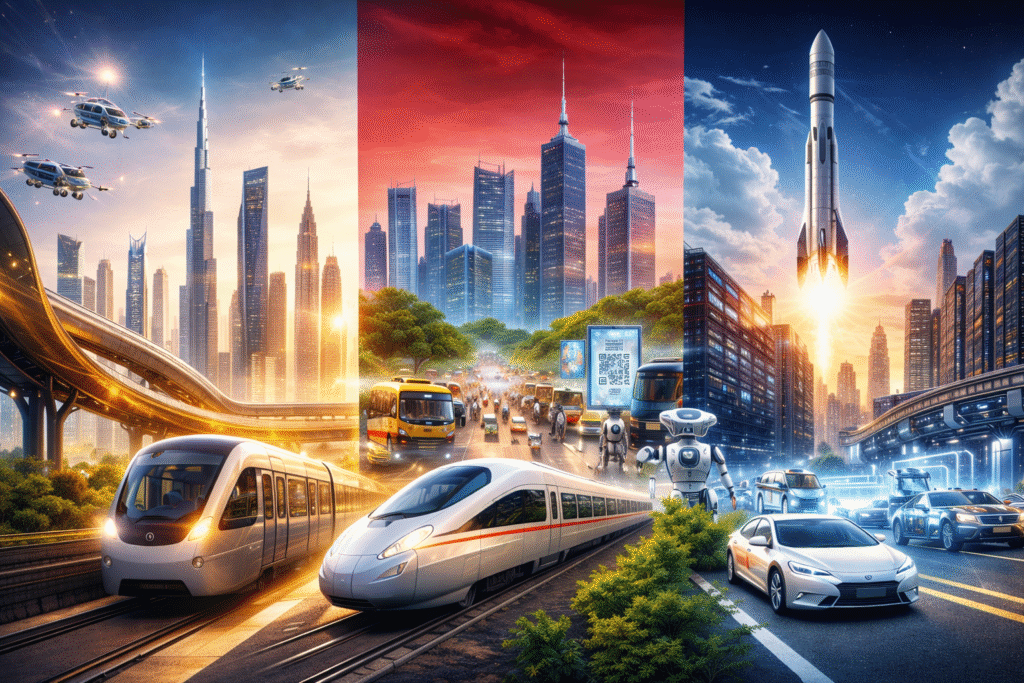
The United Arab Emirates, China and the United States are not building the future at different speeds. They are building different interpretations of progress:
-The UAE uses technology to express ambition and confidence.
-China uses it to organise society and system at scale.
-The United States uses it to reinvent markets.
The future is not a single destination. For more articles like this, visit our Tech and Innovation section.
