Jobs rarely vanish overnight. What disappears first is the justification for paying a human to do something a machine can do faster, cheaper, and without complaining about Mondays. At Tekaroid, we tend to look at these moments less as sudden disruptions and more as quiet economic adjustments.

Artificial intelligence is not ending work. But it is quietly rewriting the logic behind certain professions. There are no mass layoffs announced overnight, no dramatic turning points. The problem is that tasks are gradually absorbed by systems, responsibilities are redistributed, and roles begin to lose their importance. What makes this change hard to notice is that many of these jobs are still there. Job titles do not disappear overnight. Teams keep working, with daily routines look the same from the outside and everything seems stable. But underneath, something shifts. The question is no longer how well the job is done, but why it still needs to be done by a person at all. When that question starts to feel uncomfortable, the role begins to weaken, even if it has not officially disappeared yet.
At Tekaroid, we have decided to take a closer look at a few professions that rumours say could disappear, but how much truth is there to that?

Data entry and administrative processing
Data entry is often one of the first roles mentioned in discussions about automation, not because it lacks value, but because of how clearly defined the work tends to be. These roles exist exist to ensure that information moves reliably inside the systems, often forming the quiet backbone of larger organisations. For years, this kind of work has required human focus and discipline.
AI systems are now increasingly capable of handling these same tasks. They can read documents, extract information, and check for errors with growing reliability. This does not diminish the importance of the work itself, but it changes how it is performed.
Rather than disappearing suddenly, these roles are likely to evolve or gradually reduce in number. Data still needs to be managed. The difference is that humans are becoming less central to the repetitive parts of that process.

Customer service and support
Customer service is often mentioned in discussions about AI, usually with dramatic headlines. The reality is, to be honest, more optimistic and less apocalyptic.
What is disappearing is not customer support, but basic customer support. Password resets, order tracking, account status, billing explanations. These interactions follow scripts, and scripts are exactly what AI thrives on.
Anyone who has worked in a call centre knows that a large percentage of queries are variations of the same problem. AI handles those efficiently and humans are being moved to the cases where empathy and judgment still matter.
The job does not vanish. But the volume that once sustained entire departments slowly evaporates.

Entry-level content production
This one is uncomfortable, especially for anyone who started their career writing “just to get real experience”. AI can now generate acceptable text, images, and even video scripts at scale. Not great. Not terrible. Good enough. And in business, “good enough” is often all that is required.
Rather than devaluing content, this shift highlights what machines still cannot do well: a real or humanize judgment, context, and direction. Deciding what is worth saying, who it is for, and why it matters becomes more important than producing volume.
In that sense, entry-level roles are not disappearing so much as evolving. The opportunity now lies in learning how to think editorially earlier, rather than spending years focused only on output. Content becomes less about filling space and more about shaping meaning.

Routine financial analysis and reporting
Many junior finance roles are built around repetition: updating models, compiling reports, tracking predefined indicators, and explaining last month’s numbers again.
AI is increasingly capable of doing this continuously, in real time, and without needing Excel files emailed back and forth. The good point is that dashboards update themselves, and their insights are generated automatically, helping reports to arrive before anyone asks for them.
This does not eliminate finance professionals. But fewer people start at the bottom, and those who do are expected to add value much faster. It is not the end of finance careers. It is the end of slow apprenticeships.

Scheduling, coordination, and basic planning roles
There are entire roles dedicated to organising calendars of dates and appointments, managing and coordinate availability and logistics. These jobs exist because complexity exists.
Scheduling systems can now optimise time, predict conflicts, adjust plans, and reassign resources dynamically. What once required constant human intervention can now run quietly in the background.
The uncomfortable part is that coordination still matters deeply. It just no longer requires a person whose sole responsibility is to keep everything aligned. These roles do not disappear with drama. They fade as systems improve.
Teachers and educators
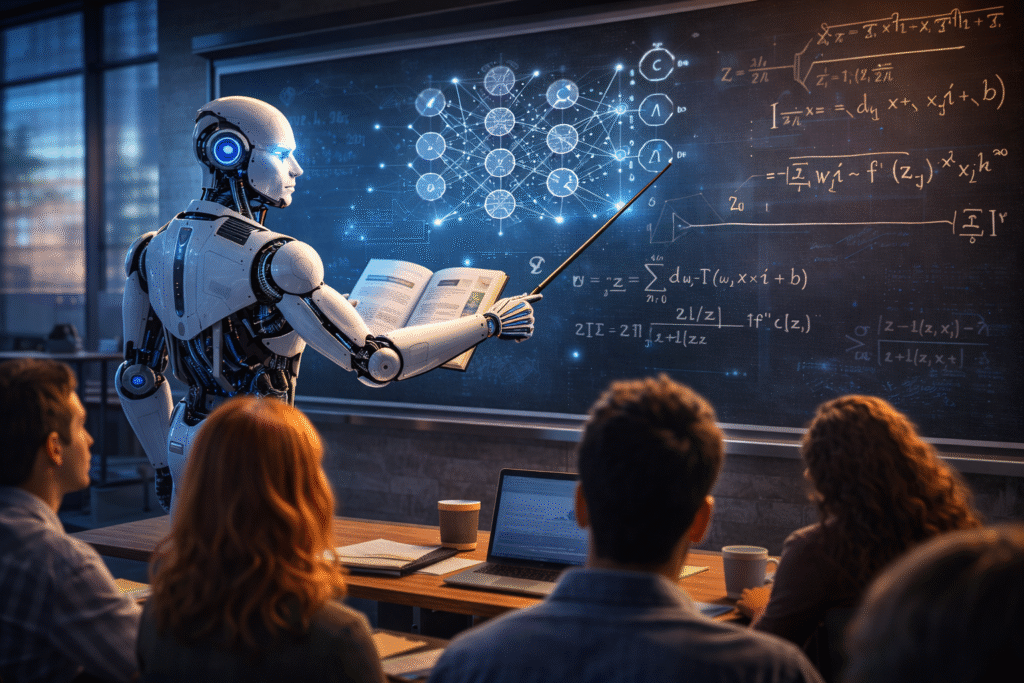
Teaching is often mentioned as one of the professions most at risk from AI. On paper, the argument seems convincing: information is available everywhere, explanations can be generated instantly, and personalised learning paths can be automated. But education has never been only about delivering information.
Teachers do far more than explain content. They interpret confusion, adapt language, motivate disengaged students, and create trust. They read the room in ways no system can fully replicate. Learning is not a transaction of data, but a relationship built over time. The idea that machines will replace educators misunderstands what education actually is. If anything, the human role becomes more central as tools improve.
Editorial note: Not everything that changes disappears
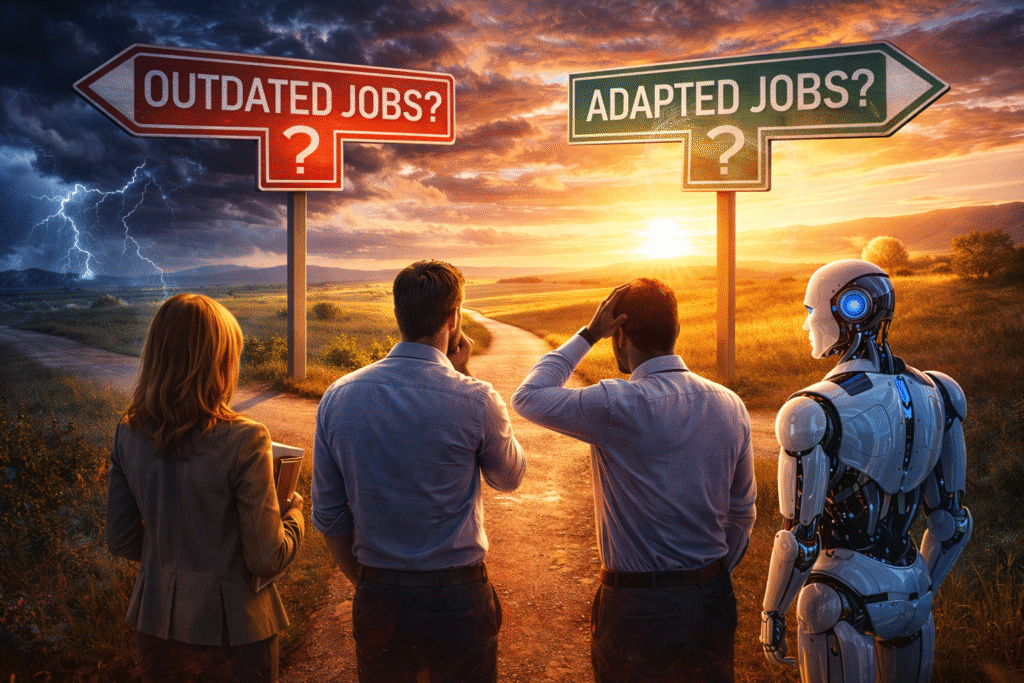
There is a strong temptation to talk about artificial intelligence as a force that only removes and destroy the human world. It is an easy narrative to sell: machines arrive, jobs vanish, people are left behind, or in a more dramatic stage, the machines arrive and kill full humanity without any important reason. But reality and history tends to be less dramatic and far more uneven.
From our perspective at Tekaroid, the roles that endure are not defined by what they produce, but by how they are exercised. They rely on judgment rather than repetition, on accountability rather than execution alone. These are roles where decisions matter, where context cannot be ignored, and where responsibility cannot be outsourced to a system.
The future of work is therefore not a simple story of replacement. It is a slower process of rebalancing, where some professions lose visibility while others gain depth. Many of the roles people fear losing may not disappear at all. It is just about being optimistic.
Discover more in our section Technology and innovation.
